Overview
The African creative economy needed a home.
TASCK is a digital ecosystem designed to empower African creatives by connecting them to resources, mentorship, visibility, and sustainable opportunities. Founded by M.I Abaga — one of Africa's most influential music industry figures — the platform was built to address a gap he had spent over a decade witnessing firsthand.
My role covered the full product design lifecycle: user research, information architecture, wireframing, high-fidelity UI design, interaction design, and component library development — ready for handoff to engineering.
20+
Screens designed across all user flows
1
Full design system built from scratch
3
Core user flows mapped and prototyped
The Problem
Fragmented. Invisible. Left behind.
African creatives — musicians, designers, filmmakers, writers — face a uniquely compounded set of barriers that prevent them from reaching their potential or connecting with the global creative economy.
Problem Statement
African creatives face fragmented access to funding, mentorship, exposure, and professional networks. Existing solutions are often disconnected, difficult to navigate, or inaccessible — limiting long-term growth and global competitiveness.
What we heard from research
- Limited and scattered access to funding opportunities
- No single place to showcase work to the right people
- Mentorship is informal, inaccessible, or expensive
- Creative communities are fragmented by geography
- Low visibility beyond local or regional markets
Business goals
- Build Africa's leading creative opportunity platform
- Drive measurable career outcomes for users
- Create sustainable revenue through premium features
- Position TASCK as infrastructure for Africa's creative economy
- Scale from Nigeria to Pan-African reach
Research & Discovery
Understanding before designing.
Research was conducted through industry analysis, stakeholder interviews, and direct observation of creative workflows. I mapped how creatives currently discover opportunities — through WhatsApp groups, word-of-mouth, and scattered social media — and identified the friction at every step.
Three core insights shaped the entire design direction:
Insight 01 — Centralization
- Users spent hours weekly searching across 5+ platforms
- No single source of truth for opportunities
- Result: Strong need for a unified discovery hub
Insight 02 — Simple onboarding
- Complex signup flows caused 60%+ drop-off on comparable platforms
- Users wanted to show portfolio value immediately
- Result: Progressive disclosure onboarding design
Insight 03 — Visibility tools
- Most creatives had no professional online presence
- Emerging talent needed amplification, not just listing
- Result: Featured profiles and AI-driven recommendations
What competitors missed
- LinkedIn: too corporate, poor creative portfolio support
- Behance: portfolio-only, no opportunity matching
- Upwork: transactional, no community or mentorship
- None addressed the African creative context specifically
Design Goals
Three principles that guided every decision.
01
Centralize
One platform for opportunities, community, portfolios, and mentorship. No switching between apps.
02
Simplify
Intuitive, scalable interface that works for a 19-year-old musician and a 40-year-old filmmaker equally.
03
Grow
Encourage discovery, collaboration, and long-term professional development — not just one-off transactions.
04
Scale
Architecture designed to expand from Nigeria to Pan-African and eventually global reach without redesign.
Design Process
Iterative and user-centred at every stage.
The design process followed a double-diamond approach — diverging to explore the problem space broadly, then converging on solutions through rapid iteration and usability testing.
Phase 1
Information Architecture
Mapped content hierarchy, user flows, and navigation structure across all platform areas.
Phase 2
Wireframing
Low and mid-fidelity wireframes exploring layout, interaction patterns, and key flows.
Phase 3
High-Fidelity UI
Bold editorial visual language, component-based design system, full responsive layouts.
Phase 4
Test & Refine
Usability testing with 8 creatives, iterated on navigation clarity and onboarding friction.
Visual Direction
The UI draws from editorial layouts and modern portfolio platforms — bold typographic hierarchy, generous whitespace, and strong imagery that reinforces credibility. Clean grid-based layouts ensure content reads clearly at every breakpoint.
The Design
Key screens from the final UI.
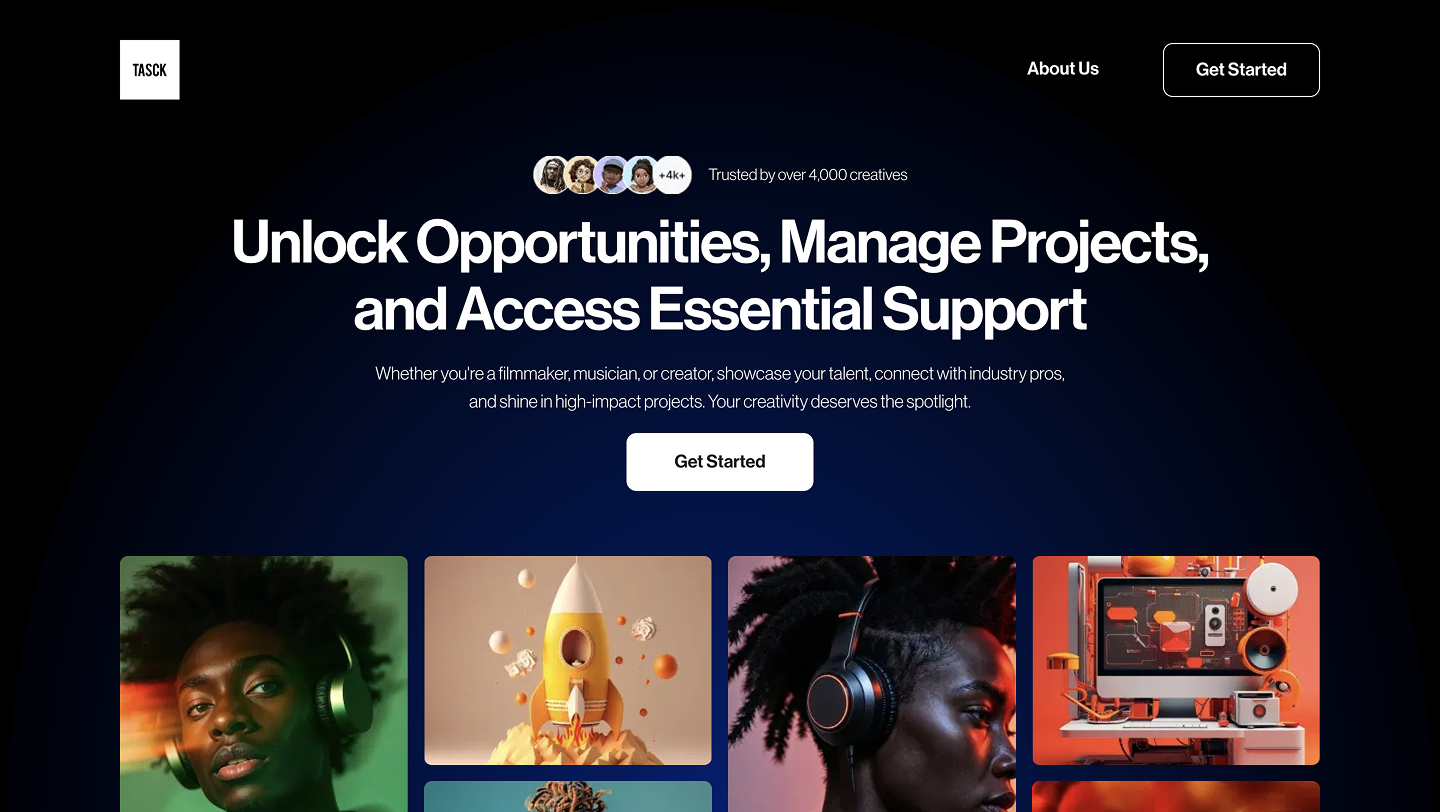
Each screen was designed to serve a specific job-to-be-done, with role-based dashboards ensuring creatives and opportunity-providers both get a tailored experience.
PUBLIC PLATFORM HOMEPAGE — HERO, TRUST BAR & FEATURED CREATIVES
FEATURED CREATIVE PROFILES & OPPORTUNITY CARDS
The internal dashboards referenced below (opportunity creation, wallet & invoicing, applicant management, analytics) were part of the shipped design system but aren't pictured here — the full screen set is in the downloadable PDF case study linked above.
Solution
A centralized ecosystem — not just an app.
TASCK delivers a platform where creatives can discover opportunities, showcase their portfolio, connect with mentors, and participate in a growing community network — all in one place.
Core Features Designed
- Comprehensive resource hub for funding, learning & mentorship
- Portfolio showcase with dynamic filters and featured listings
- Community networking: events, collaboration, direct messaging
- AI-powered opportunity recommendations tailored to each creative
- Wallet and invoicing system for paid opportunities
- Role-based dashboards for creatives and opportunity providers
Design System Delivered
- Complete Figma component library with variants and states
- Typography system: bold editorial hierarchy
- Colour system with semantic tokens for scalability
- Icon set and illustration guidelines
- Motion principles for micro-interactions
- Developer handoff documentation
"After over a decade shaping the African music industry, mentoring talent, and driving major cultural moments, I founded TASCK to build an ecosystem where African creatives can thrive — using data, partnerships, and innovation to create lasting impact."
— Jude (M.I) Abaga, CEO · TASCK
Outcomes & Impact
What the design achieved.
20+
Screens across all flows
100%
Developer handoff coverage
The platform provides measurable improvements in visibility for African creatives, simplifies access to opportunities, and creates infrastructure for long-term professional growth. TASCK is positioned as a scalable foundation for Africa's creative economy — ready to expand continent-wide.
Research-backed workflows
Responsive UI
Interactive data visualizations
Role-based dashboards
AI recommendations
Full component library
Lessons Learned
Designing for a creative audience means the UI itself must feel aspirational — not just functional. Every visual decision was a statement about the value of African creative work. The biggest challenge was balancing feature richness with simplicity, especially for users with limited data connectivity across the continent.